Piazza Navona quarter
Visit also: the neighborhoods or districts within the quarter:
(a) Via Coronari, Piazza dell'Orologio, Vicolo della Campanella
(b) Via della Vetrina, Piazza del Fico, Piazza San Salvatore al Lauro, Tiber banks.
See also the complete, natural panoramic view of the Navona area from a high observation point!
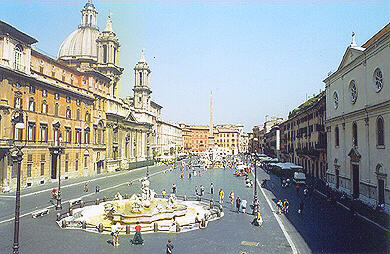
The Piazza Navona square was built exactly on the area of emperor Domitian's stadium (81-96 AD), and retains the stadium's oblong shape with a rounded north end. It was the largest in ancient Rome, larger than the Coliseum, and it could seat 50,000 spectators.
|
Piazza Navona, before the 2000 AD Jubilee renovation |
The name of the stadium was "Circus Agonalis" (competition arena),
which became corrupted to "n'Agona", and eventually "Navona". Thanks to hydraulic
engineering, naval battles engaging up to 3,000 antagonists were performed (they were called "naumachiae").
The stadium later became a baroque jewel, with masterpiece fountains (shown below), elegant palaces, and intriguing churches.
|
APARTMENTS FOR RENT IN THIS
AREA
"THE TURTLES' DREAM": wonderful four bedroom three bathrooms, amazing sitting room, separate large dining room / kitchen, terrace in historical palace facing the Turtle Fountain. Elevator. New! Highly recommended (up to 8 guests).
"The TURTLES NEST": Finest four bedroom three bathroom apartment with sitting room, dining room, panoramic terrace / roof garden with stunning Rome views, BBQ and additional kitchen, in an elegant historical palace facing the famous Tortoise fountain. Excellent fittings and equipment. Elevator! (up to 8 guests).
New! Highly recommended.
"SIGNORA TOWN HOUSE" with terrace: Finest two bedroom town house, with sitting room-dining room, large terrace, kitchen, in an elegant historical palace near Piazza Navona and the antiquary street Via Coronari. Excellent fittings and equipment.
"BOTTICELLI": elegant 2 double bedroom, sitting room, dining room 2 bathroom apt., with patio and fireplace (4-5 guests). Elevator.
"ROME DOMES": Fine 2 bedrooms 2 bathr. attic, with sitting room, dining room, large open plan kitchen, with 2 utmost panoramic terraces with views of Rome's domes, in an elegant historical palace facing the famous Tortoise fountain. Daily cleaning (4-5 guests). Elevator.
"TORTOISES": Finest 3 bedroom 3 bathroom apartment with sitting room, dining room, large terrace with views, in an elegant historical palace facing the famous Tortoise fountain. Excellent fittings and equipment. Daily cleaning. (3-6 guests). Elevator.
"ROMAN ROOFS": a one bedroom top floor apt. with ample sitting-dining room, patio and panoramic terrace overlooking old Rome's roofs and sights (up to 4 guests).
"MARCO POLO", a two double bedroom, sitting room attic with large terrace and spectacular views of all Rome (4 guests). Elevator.
"ROME PANORAMA": Large elegant designer panoramic attic near Piazza Navona, with 4 bedrooms (5 in summer) and 4 bathrooms. Two expansive panoramic terraces with 360 degree views of all Rome's sites. Elevator. Sitting room, separate dining room, fireplace. Unobtainable! (up to 6 guests). |
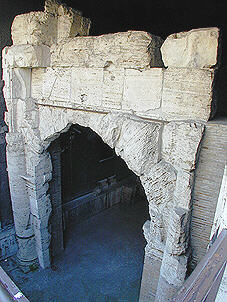
| Ruins of the ancient stadium can still be seen under the palaces (please see the bottom photo). Today the Piazza strikes visitors for its harmony and colours, combined with its elegance and charm. Varied people stroll or attend the piazza. One can find tourists, intellectuals, kids playing, freaks and elegant "signori", painters and artists selling their works right in the square.
The kaleidoscopic, lively, cosmopolitan atmosphere blending history, art, and love for life, in other words the peculiar Roman character, reaches its highest level.
|
Piazza Navona has been for long used as a place for meeting and processions. During daytime life seems to be revolving around the open-air cafes, and around the artists' stands (you can have your caricature or painting at a modest cost). Like all Rome's squares and streets, the piazza changes aspect at night, when the atmosphere becomes imaginative, people enjoy "la Dolce Vita" in full. During the Holidays, until Epiphany, a season market is held. Traditionally, parents come here to buy toys for their children.
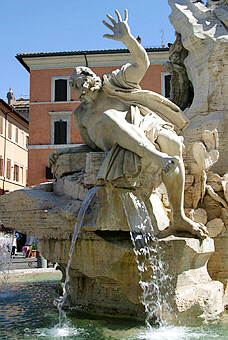
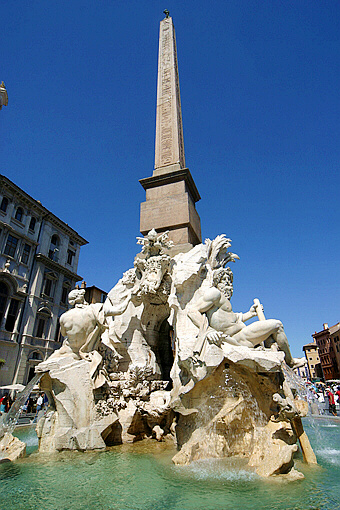
Of the 3 fountains of the Piazza, fed by the Aqua Virgo aqueduct, and which are breathtaking, the most renowned is the "Fontana dei Quattro Fiumi". (Fountain of Four Rivers - 1651 AD - right photo).
The fountain is the work of a mature Gian Lorenzo Bernini. It was commissioned by Pope Innocent X.
The Fountain has an intriguing symbolism. An obelisk from the Circus Maxentius was erected over a rocky grotto, from which a lion and a horse emerge.
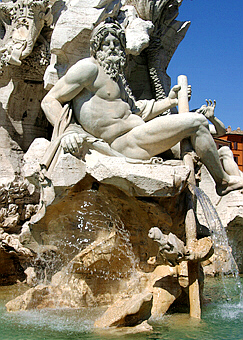
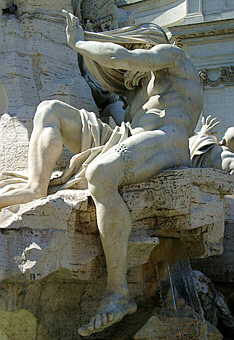
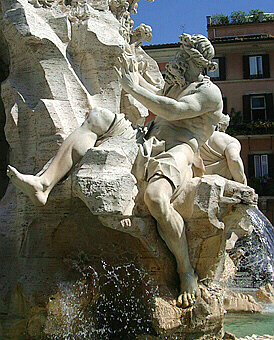
The obelisk appears to be resting on an open cavity. The large figures represent the main rivers of the four continents known at that time: the Danube, the River Plate, the Ganges, and the Nile (with a veiled head to symbolize that its source was yet unknown at that stage).
The rivalry between Borromini and Bernini is anedoctical, and according to tradition it is revealed also in the design of the Church of St. Agnes and in the Fountain of the Four Rivers.
In fact, it is said that one statue of the fountain is blind-folded in order not to look at the church (while it just symbolizes the Nile), and on the other hand the statues of the facade of the church look in a different direction, and not to the fountain in front.
Of course, these anedocts were fabricated over the century by Romans, yet they reveal the popular passion they have for architecture, and for their artists. |
|
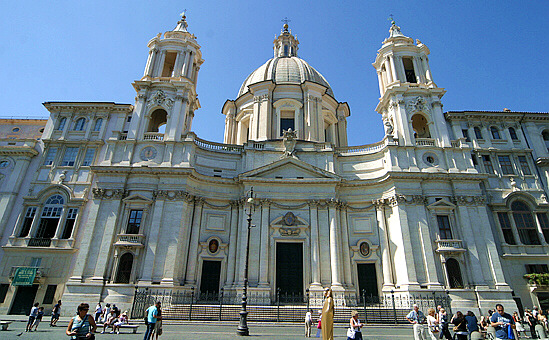 |
The church of Sant'Agnese in Agone (1652 - 1670) according to tradition, stands on the site of prostitution where St. Agnes, stripped naked, was saved by dishonour by the miraculous growth of hair.
Many architects worked on it (Rainaldi, who gave it the Greek cross design, Borromini, Bernini, Pietro da Cortona), although the concave facade, the dome, and the two belfries - all having dynamic unity - are primarily the work of Fancesco Borromini.
Left: The facade of the Church of Sant'Agnese in Agone (St. Agnes). |
Let's give now a closer look to the Four Rivers.
|
|
|
|
| The river-god representing the Ganges. The oar symbolizes its navigability. |
The river-God symbolizing the Nile is blind-folded as the source of the river was unknown at that time. |
The Danube touches the papal coat of arms, as it is the largest river near Rome. |
|
The Four Fountains are shown in the top photos, and also in the left photo, below.
|
As mentioned, the rivalry between Bernini and Borromini is symbolized - in the imagination of Romans - in the layout and design of the statues.
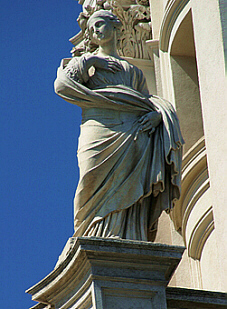
In fact one statue of the fountain is blind-folded, seemingly in order not to look at the church (while it just symbolizes the Nile, whose source was still unknown at that time), and on the other hand the statues of the facade of the church look in a different direction, and not to the fountain in front.
(Left): The river-God of the Rio della Plata is scared by a snake, symbolizing the fear of rich men that their money could be stolen.
A legend is that Bernini positioned the cowering Rio de la Plata River as if the sculpture was fearing the facade of the Church of St. Agnes by his rival Borromini could crumble against him; in the reality, the fountain was completed several years before Borromini began his church.
(Right): The statues of the facade of St. Agnes seem to avoid looking towards the fountain. |
 |
The other two fountains in the square are masterpieces by Giacomo della Porta.
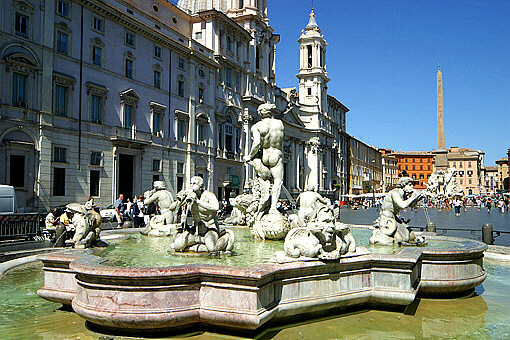 |
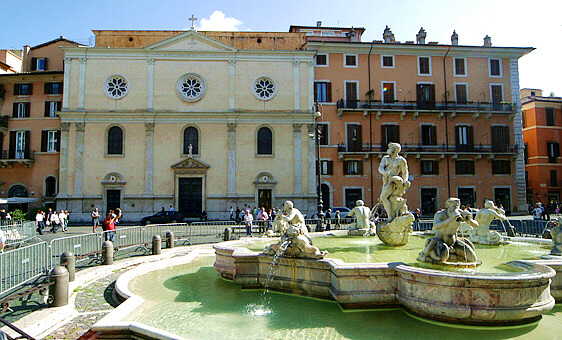
The Fountain of the Moor is at the southern end of the square, in front of Palazzo Pamphilij and near the Church of St. Agnes.
The four Tritons anf the basin are work of Giacomo della Porta (1575) to which Bernini in 1673 added the statue of a Moor, or African.
In the photo below you can see a side view. |
Back to top
The church Nostra Signora del Sacro
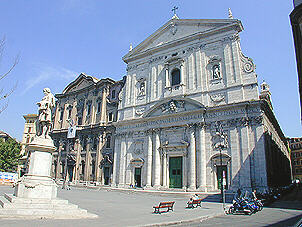
Cuore (Our Lady of the Sacred Heart Church - right photo, showing also the Fountain of the Moor - is situated in the opposite side of St. Agnes.
It
dates from the period of Alexander VI (1492-1503). It was called San
Giacomo degli Spagnoli and it was Spain's national church in Rome.
Also Palazzo Braschi, in the southwest corner, should be mentioned.
Begun in 1792 by C. Morelli for the nephews of Pius VI, in was sold
to the State, and presently it hosts the Museo di Roma, with sculptures,
paintings, drawings, prints illustrating the history of Rome from
the Middle Ages. The collection includes works by Canova, and views
of Rome by Ippolito Caffi. |
|
The Fountain of Neptune is also known as the "Calderari", because of its close proximity to the workshops of the artisans who worked with copper.
The basins are work of Giacomo della Porta. It remained bare until the 19th century. The statue of Neptune by Antonio Della Bitta was added in 1878 to make that fountain more symmetrical with La Fontana del Moro in the south. It shows Neptune struggling with an octopus, surrounded by sea nymphs. |
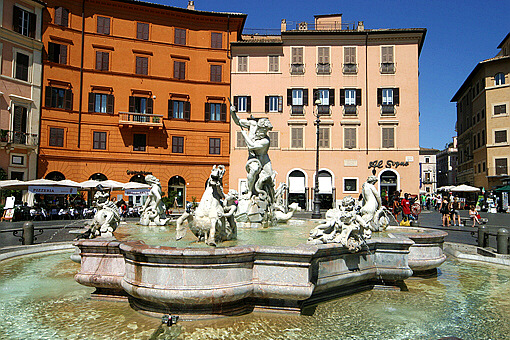 |
Of all
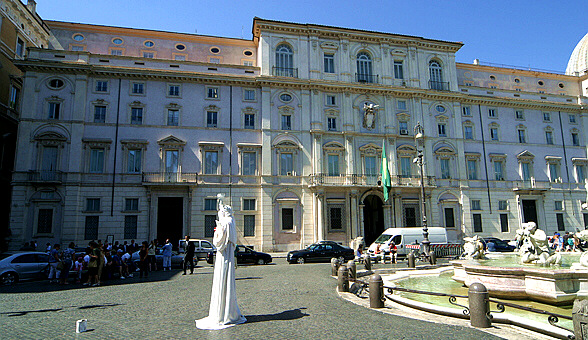
the many buildings in the piazza, noteworthy is also the Palazzo Pamphilj.
Palazzo Pamphilj is situated at the left side of St. Agnes (right photo). It was designed by Rainaldi,
and it is endowed with frescos by Piero da Cortona. The palace was purchased in the early years of the 20th century by the Brazilian state, and it is now the seat of the Brazilian embassy and consulate in Rome.
|
 |
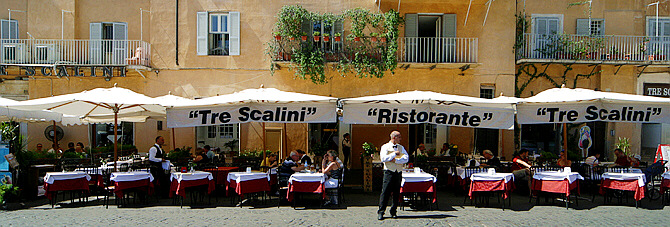
In Piazza Navona you find among Rome's most famous restaurants, as the "Tre Scalini" (Three Steps).
You find myriad restaurants, of all types and prices, around the square.
Back to top
THE AREA JUST AROUND THE SQUARE
Around the square you find a great number of churches, fountains, statues, museums, and naturally also restaurants, cafes, hotels, and clubs.
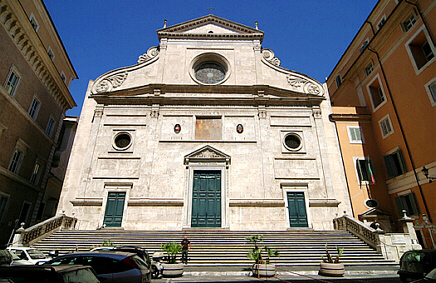
Sant'Agostino is near the Navona square. Its construction began in the 13rd century, although the facade was finished in 1483 by Giacomo di Pietrasanta, using marble from the Coliseum. The facade resembles the church of Santa Maria Novella in Florence.
The most famous work of art presently in the church is the Madonna di Loreto, by the world-acclaimed painter Caravaggio. The church also contains a Guercino canvas of Saints Augustine, John the Evangelist and Hyeronimus; a fresco of Prophet Isaiah by Raphael; and the statues of Madonna col Bambino, by Andrea Sansovino and of Madonna del Parto by his pupil, Jacopo Sansovino.
The latter sculpture is reputed by tradition to work miracles and was, according to a legend, based on an ancient statue of Agrippina holding Nero in her arms.
The church also houses Melchiorre Caffà's sculpture St. Thomas of Villanova Distributing Alms, completed by his mentor Ercole Ferrata. |
|
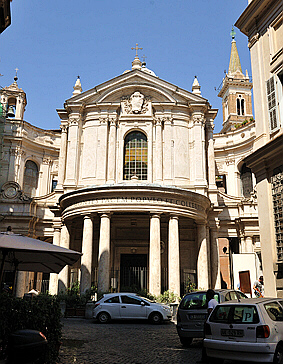
One of the most noteworthy churches near the Piazza is the Church of Santa Maria della Pace.
|
Santa Maria della Pace church
|
|
The elegant facade of the church dominates
the adjacent Piazza della Pace, towards the west of the northern end.
The first reconstruction of this sanctuary was undertaken by B. Pontelli
at the behest of Sixtus IV, in 1482.
The pope Julius II chose the name "della
Pace" to anticipate the peace he hoped to restore in Italy. In
the 17th century, under Alexander VII, the church was rebuilt again
by Pietro da Cortona. A series of Corinthian columns give rhythm to
the upper part, beneath it a circular portico supported by Doric columns
projects into the piazza.
Inside, a short rectangular nave is followed by an octagonal
central body, by Bramante. The first chapel to the right, the
Chigi Chapel, contains Raphael's famous Sibyls fresco.
To the
left you find a passage to the sacristy and then to the cloister
(1500-1504), still by Bramante, who determined the proportions
to ensure remarkable effects of shade and light. |
|
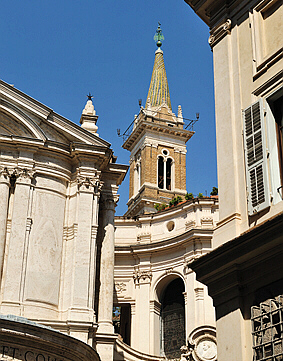
Close-up of the intriguing belfry, belonging though to another church, Santa Maria dell'Anima (Our Lady of the Soul).
|
|
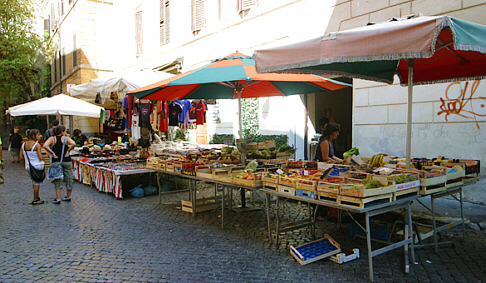
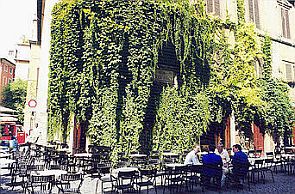
The street departing from the church, Via della Pace, has an "L"
shape. In its first part there are two cafes, among the liveliest and
trendiest in Rome, especially at night. In the second part, towards the
Piazza del Fico, there is a little morning market.
|
Via della Pace, American tourists shopping in the street morning market
|
|
|
Via della Pace, the Caffè della
Pace
|
|
Back to top
|
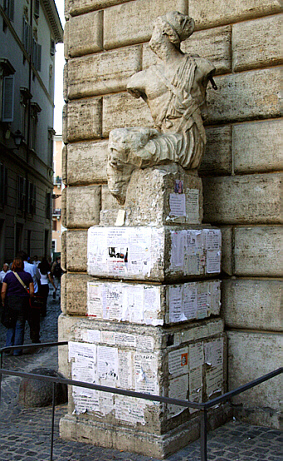
To the west of the southern end of the Piazza Navona
is an ancient copy of a Hellenistic statue from Pergamon, part of
a group representing Menelaus carrying the body of Patroclus, known
as Pasquino (the piazza in front of it is the Piazza Pasquino).
The statue is so warn out that when it was discovered some wanted
to get rid of it. Bernini on the contrary like it.
People have begun
using it to present protests (called "Pasquinate", the
famous "pasquinades"), or their point of view about things.
They are sitcked on the pedistal, making it one the "talking statues"
of Rome.
From Piazza Pasquino there departs westwards the Via del
Governo Vecchio.
|
|
Oratorio dei Filippini, and Santa
Maria
in Valicella, the "Chiesa Nuova" ("New
Church")
|
At No. 39 is the Palazzo del Governo Vecchio (Old Government Palace), built between 1473 and 1477, which became the official residence of the Governor of Rome in 1624.
It acquired its present name when the government was moved to Palazzo Madama by Pope Benedict XIV (mid-18th century). Following Via del Governo Vecchio one reaches westwards Piazza della Chiesa Nuova. The two adjacent facades overlooking the Piazza belong to Santa Maria in Valicella, known as the Chiesa Nuova ("New Church"), and the Oratorio dei Filippini (Oratory of St. Philip Neri). Gregory XIII gave the church to the St. Philip's Neri Oratorian Confederation, who commissioned its rebuilding in 1575.
|
The reconstruction was entrusted first to Matteo da Citta' di Castello,
and then to Martino Longhi the elder. The facade is by Paolo Rughesi,
completed in 1605. The interior has rich baroque decorations. Caravaggio
supplied the Descent from the Cross, later moved to the Vatican, and
replaced with a copy (second chapel to the right). The choir has three
masterpieces by the young Rubens. The splendid frescoes in the apse,
the cupola and the nave were all painted by Pietro della Cortona (1650-1655).
The adjoining Oratory of the Filippini, by Borromini, contrasts with
the more conventional facade of the Chiesa Nuova, and was built in
bricks, in accordance with the wishes of the Oratorians. It is full
of movements thanks to Borromini's use of curves. The entire compound
is slightly concave, yet the central bay is convex at the ground floor,
and is concave in the floor above. The windows are ornate.
|
As you walk back to the northern end of Piazza Navona, you find that it is surrounded by two elegant squares: the green Piazza Febo, and Piazza Cinque Lune (Five Moons Square). As you can see in the right
photo, the palazzi surrounding the Piazza Navona are built on top
of the "cavea", the stepped stone seating, designed to accommodate 50,000 spectators. |
|
One of the entrances of the Domitian
stadium,
which is beneath the palaces encircling the square.
|
|
You can visit the ancient Roman monuments
beneath the Piazza Navona and Campo Marzio area. The entrance in
Piazza Tor Sanguigna 13 (behind the palazzi of the northern part
of Piazza Navona). There are guided tours in English on Saturday
and Sunday between 10 AM until 1 PM, and on Tuesday and Saturday
between 9 PM and 11 PM. The entrance fee is only 6 Euro appr. 8 US$.
The tours are also in French, German,
Spanish but on demand.
Information and reservation: tel. 062412352
and 062413287.
Back to top
To visit the other quarters or sights, please go to: |

Visit Rome | Rome panoramic views | Rome apartments and villas | Inquire | Rome travel guide | Rome map | Service | Resources
Roman Homes homepage |
|