Rome Appian Way - Appia Antica
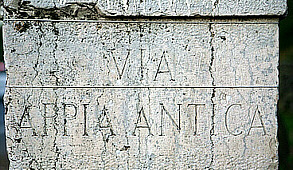 |
All roads lead to Rome, but only the Appian Way or Via Appia was also called Via Sacra (Sacred Way), and dubbed Regina Viarum (Queen of Roads).
Index
|
VILLAS FOR RENT IN THIS AREA
Villa in the Appian Way park in Rome(!): Scenic, sophisticated villa with pool and large garden, for refined parties and weddings with exquisite catering, for 12-200 persons. It also host 12 persons in 6 suites. Nearby archaeological excursions, golf, biking, and tennis.
Villa di Fiorano - Appian Way: Amazing elegant 18th century large villa, with large park, fountains and swimming pool - suitable for celebrations, weddings and parties, with fine catering. |
The sumptous name did not originate out of coincidence. Rome was the most northern of the 30 towns forming the Latin Confederation, and so special consideration was given the road leading South, to the fatherland of the Latins, and also further afield to Magna Graecia in Southern Italy, IE to the cradle of the Italian Civilization.
|
| 
|
|
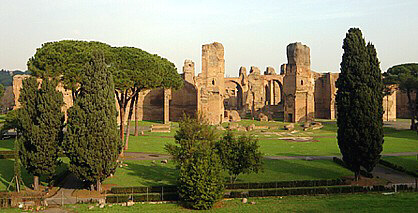
| Caracalla's Thermae |
The road begins at Capitol Hill. It passes through the Roman Forum leaving it just after the Arch of Titus. It borders the Palatine and the Circus Maximus, and also Caracalla's Baths, reaching the imposing gate of St. Sebastian.
Caracalla was emperor Septimius Severus' son. The gigantic baths, which could host up to 2,000 citizens, were Rome's second largest, as Diocletian's bath in the Esquiline were also larger. The imposing compound included three gigantic covered pools (with hot, warm and cold water), gyms, halls for meetings and lectures.
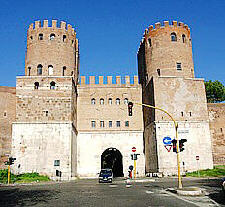 |
As mentioned, the road soon reaches the gate of St. Sebastian of the the Aurelian Walls, encircling the historical centre.
Just after the gate, you first find the site where St. Peter according to the tradition had a vision of Jesus (Domine, quo vadis? Lord, where shall I go?) when he feared that he would meet his caputre and death in Rome.
The first walls of Rome were the Servian, built by the king Tullius Servus. Part of them can still be seen near the Termini train station.
Left: St. Sebastian's gate |
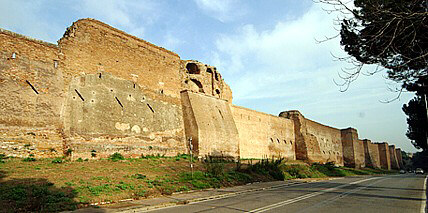 |
Marcus Aurelius fortified the town in the 3rd century AD with imposing walls, interspersed with high towers, largely extant today.
For many centuries they defended the town, although the Alaric's Goths managed to break through in 410 AD.
Left: the imposing Aurelian walls, encircling all the historical centre of Rome. |
| The street is famous for its cobblestones. It was in fact the first paved street of humanity, after the work of consul Appius Claudius in 312 BC, from which it takes the name. |
The road was paved until the first town south of Rome, called Bovillae, where from the Gens Julia, the family clan of Julius Caesar originated.
|
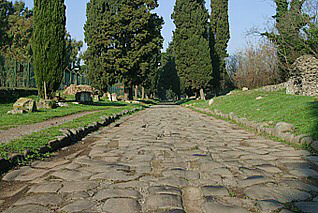 |
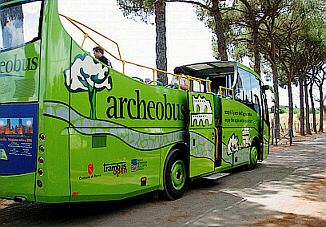
The archeobus is the circle line of the sights of the Appian Way, connecting it to the city centre. Only in the hot months it has an open-deck. |
The famous cobblestones of the Appian Way |
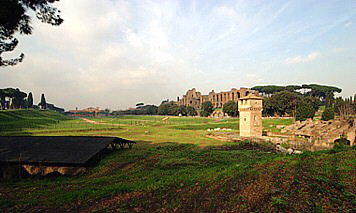
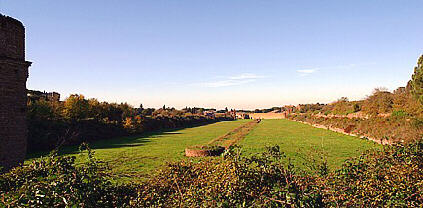
Along the Appian Way you find the Catacombs of St. Sebastian and also of St. Callistus. One mile after you find the Circus of Maxentius, the Mauseoleum and the house of Romulus (the founder of Rome), and just after it, the Tomb of Cecilia Metella, daughter of a Roman patrician family.
|
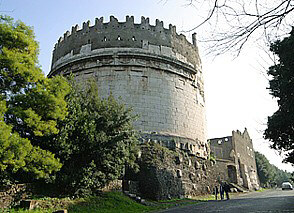 |
The Circus of Maxentius |
The Tomb of Cecilia Metella |
The tomb was later transfomed into a fortress by the Caetani family, who imposed a toll in the Middle Age. There is also an adjoining convent, now transformed into an archeological museum (entrance: 5 Euros).
Right: the Tomb of Cecilia Metella
and the adjoining convent, currently a museum. |
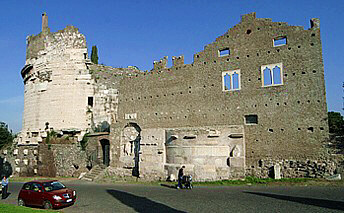 |
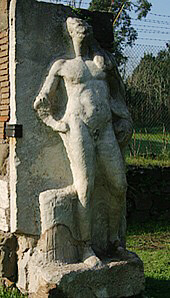
The Appian Way is famous for its imposing funerary monuments, and for the statues which flank it.
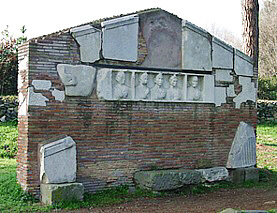 |
 |
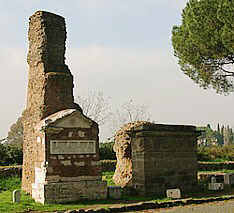 |
A funerary monument along the way |
A statue along the way |
Another funerary monument along the way |
|
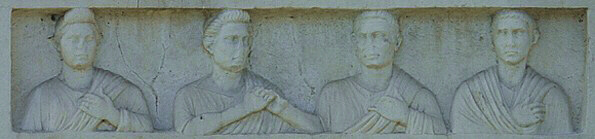
The bas-reliefs of the family members of this grave, called "The frontespice monument" |
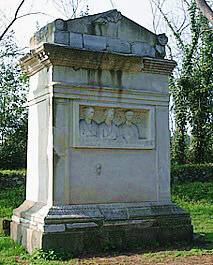
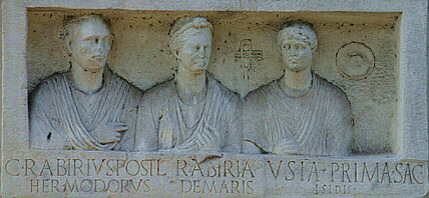
One of the most notable tomb pertains to the Rabirii Family, which is near the intersection of the Appian Way and Via Erode Attico.
 |
 |
The Rabirii family tomb |
The Rabirii family tomb bas relief |
Just after the intersection with Via Erode Attico you find the Quintilii Family villa (Villa dei Quintili). They were Roman notables near to the emperor, who fell in disgrace for which they were killed and their properties were confiscated.
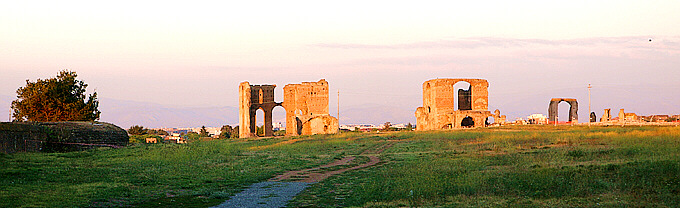 |
The Quintilii Villa, at sunset |
The aqueduct Claudius is nearby, and it is still well preserved. |