Via dei Coronari, Piazza dell'Orologio, Via della Vetrina, Piazza San Salvatore in Lauro, Piazza Panico -
near Piazza Navona
These pages present the most notable aspects of the districts of the Navona "Signora" Town House and the Navona "Roman Roofs" attic. |
- The Navona "Signora Town House" and "Roman Roofs" attic neighborhood: Via Coronari, Piazza dell'Orologio, Piazza San Salvatore al Lauro, Vicolo della Campanella, Piazza del Fico (this page).
|
Let's have a stroll from the strets and piazzas near the properties, roaming around the most intriguing neighborhood.
Between Via dei Coronari and Corso Vittorio Emanuele you find the famous Oratory of the Filippini brothers, which was designed by Francesco Borromini. As opposed to his rival architect/sculptor Gian Lorenzo Bernini, Borromini believed that the ultimate meaning of architecture was to design and to assemble the content of structures, which covered the empty space, while Bernini believed the opposite, IE that empty space was the most important feature, and structures built around them had to stress the concept (think for ex. about St. Peter's colonnade, one his masterpieces).
Borromini also preferred curved profiles, in all forms, and in which he excelled. The elegance and the ingenuity of his works are outstanding.
 |
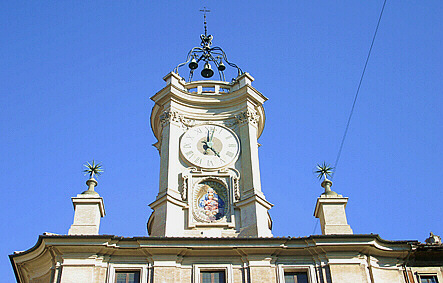 |
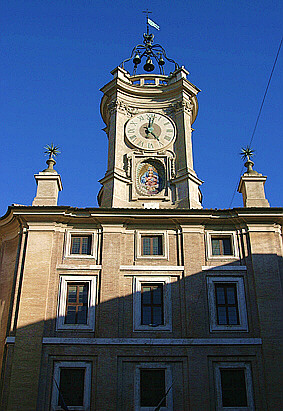
Piazza dell'Orologio: the Oratory and Convent of St. Philip Neri friars (Oratorio dei Filippini) designed by Francesco Borromini between 1637 - 1640. |
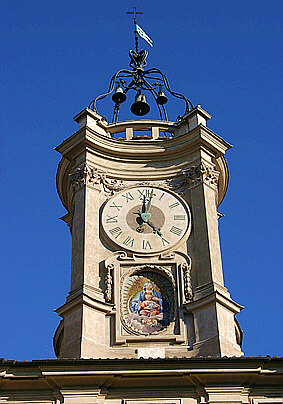
Close-up on the marvellous Torre dell'Orologio (Clock Tower)
designed by Francesco Borromini. The "Roman Holiday" film fans probably recognize that this is the clock which could be seen from Joe Bradley's window. |
Within the oratory layout, the famous Torre dell'Orologio or Clock Tower stands out with its intriguing elegance.
|
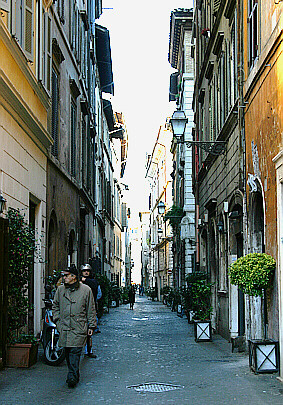 |
Further close-up of the Torre dell'Orologio |
Via dei Coronari |
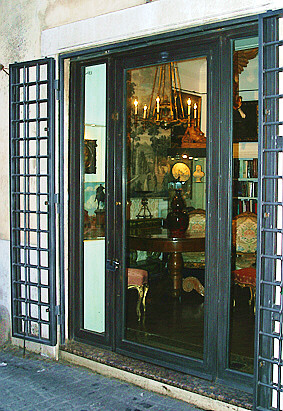
The most important street of the west district of the Piazza Navona quarter is Via dei Coronari, or "Crown makers street", taking its name from the craftsmen preparing crown of flowers between the 16-19th century. Today it is rather the iconic street of antique art dealers.
|
 |
An antique dealer shop and workroom
|
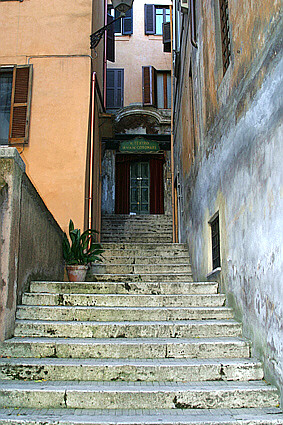
A characteristic house in Via dei Coronari,
preceded by a flight of steps accessing it |
Along Via dei Coronari you also find wall altars dedicated to St. Filippo Neri. You also find picturesque houses, with characteristic stairs (photo above).
 |
 |
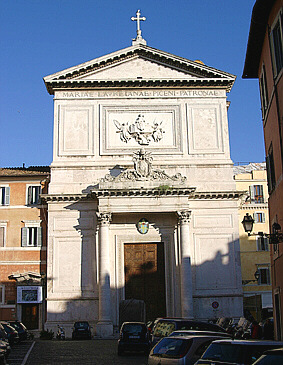
The Church of San Salvatore in Lauro |
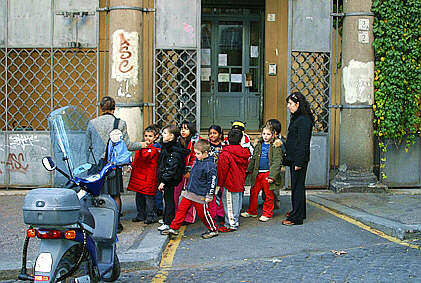
Kids leaving school with theirs teachers |
The most notable church of the district is the Chiesa di San Selvatore al Lauro, a 17th century church. Near to it, you find a grammar / junior school. The flocks of kids, giggling and chatting, bring joy to the square, making it lively.
 |
 |
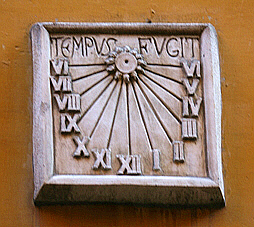
A sun dial in Piazza San Salvatore in Lauro |
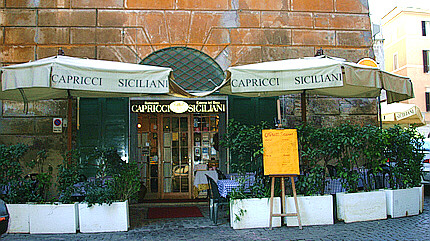
One of the many fine restaurants in the area: "Capricci Siciliani", or Sicilian Whims, with typical Sicialian specialities (cannoli, finest wines, Pasta alla Norma etc.) |
There are innumerable shops, cafes, restaurants in the district. You also find a laundry (in Via della Vetrina), and also two "Carrefour" supermarkets, one in Via Coronari, and one - which we recommend - in Via del Governo Vecchio, as it is has more supplies and the personnel are kinder than the one in Via Coronari.
In the district you find a maze of characteristic little streets and alleys, mostly having picturesque names.
|
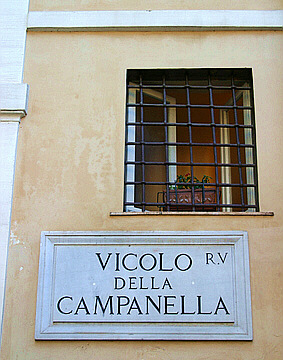
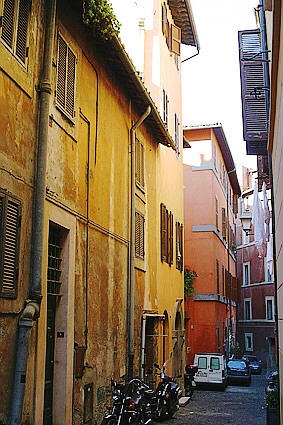
For ex. the Vicolo della Campanella (Little Bell Alley) which is so called because it leads to a little church bearing the same name) has old buildings, as it is normal in Rome built in turn on the ruins of ancient Roman palaces.
Left: the marble slab introducing Vicolo della Campanella ("Little Bell Alley").
Right: Vicolo della Campanella
In the street you find both well renovated palaces, where tenants usually belong to the educated middle-class, and also simpler, palaces. As it occurs with all Romans, people are happy and not ashame of their social status.
|
 |
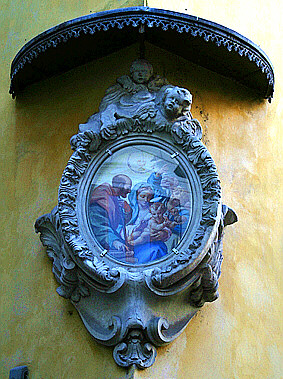
The characteristic little street has its name (Vicolo della Campanella or "Little bell alley") , it has two Marian works of art on her walls.
 |
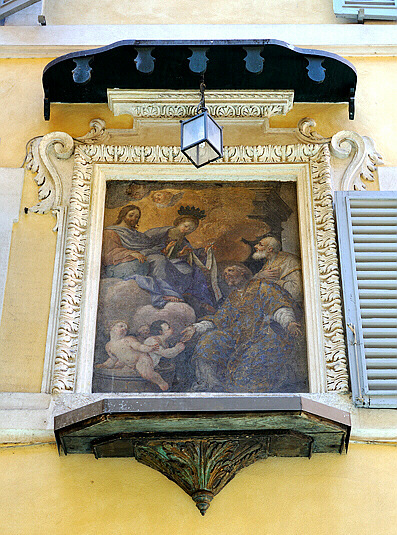 |
The wall work of art dedicate to Mary at the beginning of the street. It shows St. Filippo Neri (St. Philip Neri) worshipping Mary |
A noteworthy and typical feature of Rome are the Marian shrines, or work of art dedicated to Our Lady, in the walls of palaces. In Via Coronari and in Via della Campanella you find beautiful ones dedicated to St. Philip Neri and to Our Lady. It displayes Mary, Jesus, St. Thomas, St. Philip Neri and the so called "Miracle of the three children". . |
The two shrines dedicated to St. Philip Neri shrine depict St. Filippo Neri worshipping Our Lady and Jesus.
 |
 |
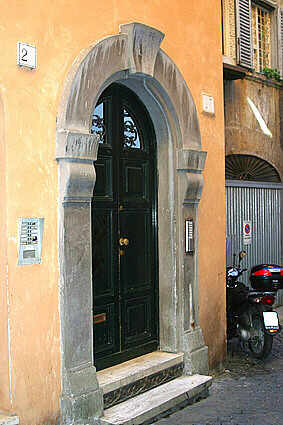
A characteristic front door of the palaces in the district |
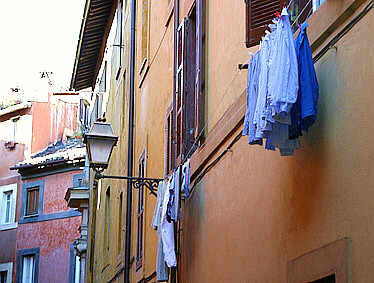
The spontaneity of the inhabitants, hanging their clothes outside a little alley |
In the left photo below you see the front door of a typical palace in the district. Both the columns and the vault are made in granite stone, frequently recycling ancient Roman granite.
In the area you also find wall sundials, small fountains, and naturally many restaurants and cafes, suiting all tastes and wallets.
Back to the Navona "Signora" Town House with terrace presentation

Visit Rome | Rome panoramic views | Rome apartments and villas | Inquire | Rome travel guide | Rome map | Service | Resources
Roman Homes homepage |

