ROME BORGHESE GARDENSFor a complete presentation, please visit the specific pages on the streets of the quarter:
|
APARTMENTS FOR RENT IN THIS QUARTERBorghese Gardens "PARIOLI VILLA": elegant five bedroom five bathroom villa with triple sitting room, separate dining room, TV room, large elegant conservatory room, table tennis room, fitness room, garden with sitting area (up to 10 persons). "ROME SEAGULLS": luxury panoramic attic penthouse, with two terraces with stunning views of all Rome, two bedrooms (matrimonial and twin beds), two sitting rooms, two sparkling bathrooms, kitchen. Remarkable equipment. Elevator. "Leonardo" (Via della Croce), a three bedroom, sitting room, 2 bathrooms, terrace apartment in an 18th century palazzo (2-6 persons). "Anita" (Via delle Carrozze): a large upscale suite with three bedrooms, sitting-dining room, three bathrooms, large kitchen, remarkably equipped (3-6 persons). "Regina" (Via San Giacomo): a large upscale suite with three bedrooms, sitting room, separate dining room, three bathrooms, large roof garden, balconies (3-6 persons). "Valentino" (Via Sistina): an upscale panoramic topfloor apt., with master bedroom, sitting room, separate dining room, two bathrooms, a patio and a large terrace overlooking all Rome (2-3 persons). "Three Coins" (Vicolo del Forno): A one bedroom attic with ample sitting-dining room, and a panoramic patio overlooking old Rome's roofs and the Trevi Fountain (2-3 persons). |
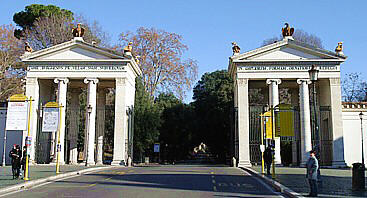
The main entrance is from Piazzale Flaminio. The large pen gate open 24/7, introduces a road which crosses the entire park from North to South. The first section of the road is dedicated to former New York's mayor Fiorello La Guardia. Yet the entrance most people use is directly from the Spanish Steps. In fact, if you climb the Steps, and turn right, after less than 100 meters you are already in the park, in the most panoramic section overlooking Rome called "Pincio".
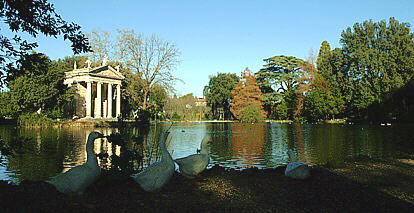
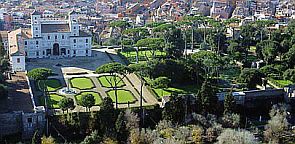
Towards the end of the Fiorello La Guardia avenue, you find the imposing Villa Medici, which is owned by the French government. It hosts the French Academy of Fine Arts, where French scholars of Italian Renaissance live with scholarships. The Villa has a phenomenal Italian garden, hardly accessible to the publish, and of which you can see above an aerieal view, taken from a hot air baloon which flew regularly from the Borghese Gardens in the years 2002-2005. Other highlights of the park, near the Villa Medici, are a lake with geese and swans, dedicated to Aesculapius (above photo), where you can hire a boat and row, and the Piazza Siena, an equestrian stadium where international competitions are held (the 1960 Rome Olympic equestrian games were held here).
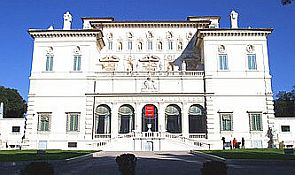
The section called "Pincio" has a great view of Rome, especially at sunset. The Park is home also to the world-acclaimed Borghese Museum, situated in the former villa of Cardinal Scipio Borghese. The Museum has an staggering collection of Renaissance and Baroque paintings, of (among few) Caravaggio, Pinturicchio, Raphael, and Rubens. In the ground floor you find also masterpieces of the Bernini father and son, including the famous "Ratto di Daphne" (Daphne capture), for which Gian Lorenzo Bernini (son) was rightfully considered the new Michelangelo.
Visit Rome | Rome panoramic views | Rome apartments and villas | Inquire | Rome travel guide | Rome map | Service | Resources Roman Homes homepage |